
‘Just look at those fools,’ Marzanna sighed, squinting her dark eyes at the cheering group of villagers gathered around a burbling brook.
‘I thought you’d get used to it by now. They burn you and drown you every spring,’ replied Vesna.
‘And proclaim their undying love for you,’ added Marzanna.
‘They believe that they are celebrating my victory over you,’ a smirk danced on Vesna’s lips, ‘but what they don’t know is that without you, there wouldn’t be me.’
‘They don’t know any better. They can’t see further than their empty bellies,’ Marzanna shook her head. ‘They’ve lost the ability to truly look at nature, to take in its splendour. It’s been ages since I stumbled upon a youth admiring the beauty of winter, the crystallised pines, the plummeting snowflakes in the forest clearings.’
Vesna looked amused. ‘The beauty is in the change. The change itself is beautiful,’ she said, caressing a swallow perched on a willow tree heavy with catkins. ‘Anyway, what do you do with these snow-enthralled youths?’
‘Nothing,’ replied Marzanna.
‘Nothing?’
‘Precisely, my dear, I do nothing. I leave them be,’ she paused, ‘and let them find their way out of the white woods on their own.’ Her joyful cackle startled the swallows into a hectic flight.
Vesna could not stop her lips from stretching into a soft smile. ‘You’ll never change,’ she said, taking Marzanna’s pale hand in hers.
‘That’s the point of it all. Constancy. Repetition. Giving them,’ she nodded at the reeling villagers, ‘something to expect, to yearn for, to rely upon, so that they could organise their predictable lives around our comings and goings.’
The wind whistled through the branches of Iriy, the lush garden in the crown of the World Tree.
‘Speaking of goings,’ a subtle sadness crept into Vesna’s voice, ‘Stribog’s steed is already here to take me.’
Marzanna pulled her into her cloaked embrace and let her head rest on Vesna’s warm shoulder. The scent of wild grasses and woodland flowers rose like a whirlwind, snaking around Iriy.
‘Good luck, my friend,’ she whispered.
‘Don’t be lonely in Nav,’ Vesna said gently.
‘Don’t you worry about that. I hear Chernobog has devised new ways to keep me entertained in the world of the dead,’ Marzanna smiled, her gaze drifting into the distance.
Vesna gave her cold hand another squeeze, then turned and mounted the stormy steed sent by the wind god. She waited a few heartbeats before prodding the beast into the skies, her eyes lingering on the swirling form of Marzanna’s dark cloak as she descended the World Tree and vanished in the dark mouth of Nav.
***
Vesna, Slavic Goddess of Spring
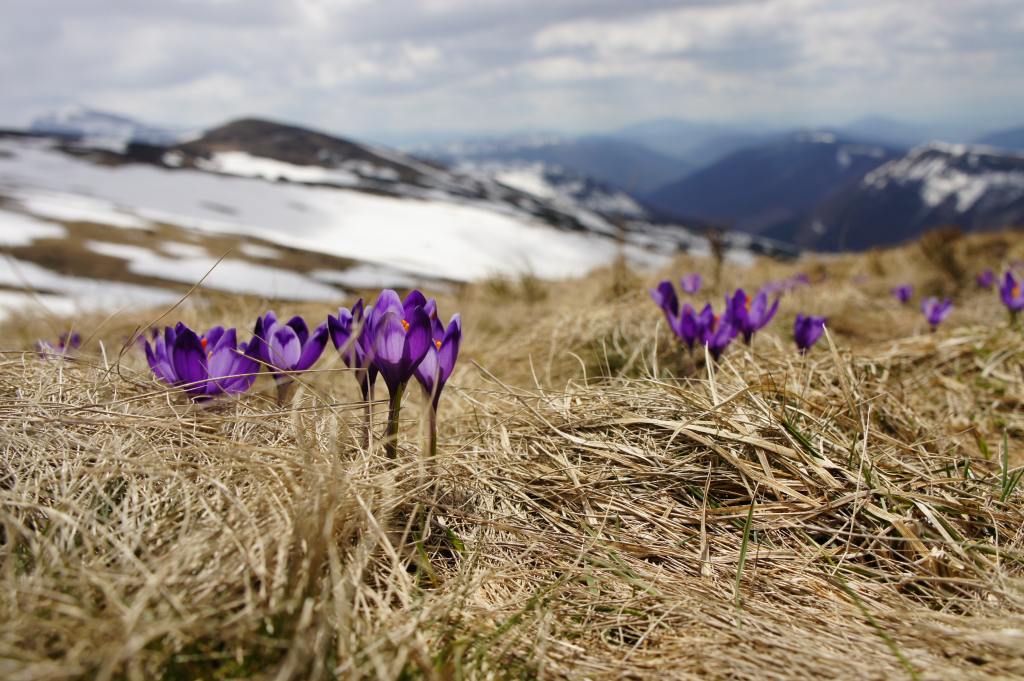
There is a moment, somewhere between the last frost and the first green shoot, when the world seems to hesitate.
Winter has not fully loosened its grip, but something beneath the surface begins to stir. The air softens. The light lingers just a little longer. Snow gives way, not all at once, but in quiet surrender.
In Slavic mythology, this moment belongs to Vesna, a Slavic parallel to the Greek goddess Persephone, the goddess of spring, youth, and renewal.
She does not arrive suddenly. She returns.
Unlike the harsh certainty of winter, Vesna moves softly. She is not a force that demands attention, but one that unfolds. Her presence is felt in small changes: the first buds on branches, the thawing of rivers, the distant sound of birds returning.
She is often imagined as young, radiant, and light-footed, moving across the land and waking it from its long sleep. Where she passes, the earth remembers itself.
But Vesna is not simply a symbol of beauty or warmth. She represents transition. The fragile space between what was and what is becoming.
Spring, after all, is not stable. It is unpredictable, shifting, and sometimes hesitant. And so is she.
The Dichotomy between Vesna and Marzanna
Vesna’s existence is intertwined with her diametrically opposite Marzanna, the goddess of winter and death. They are the forces that represent the change of seasons and that keep the ancient Slavic world spinning in a cycle of death and rebirth. Their relationship is not one of simple opposition. Slavic gods do not exist in clean divisions of good and evil. Vesna does not defeat Marzanna in battle. She follows her. She replaces her. She continues the cycle.
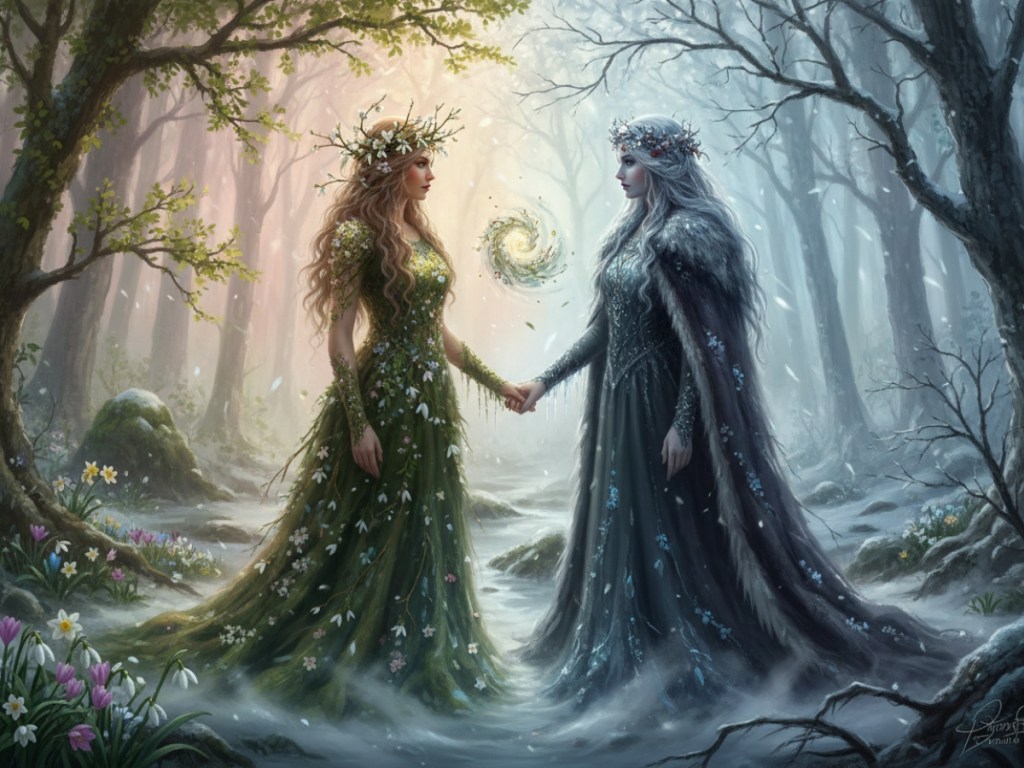
Vesna is one of the most beloved deities among the Slavs because of her beauty and bounty. Her arrival signifies the ending of Marzanna’s cold and cruel reign, blemished by famine, illness, and death. Slavs, especially Southern Slavs, still often name their daughters after the goddess Vesna, believing that they will be as generous and joyous as the goddess herself.
Around the beginning of March, Slavs performed spring rituals that involved the drowning or burning of Marzanna’s effigy, whilst the effigy of Vesna, decorated with flowers and leaves, was carried by a procession marching out into the fields and singing songs of praise to the goddess. The ritual of casting Marzanna into the river marks the transition between seasons. It is both an ending and a beginning. As winter is carried away, Vesna is welcomed back.
There is no triumph here, only rhythm.
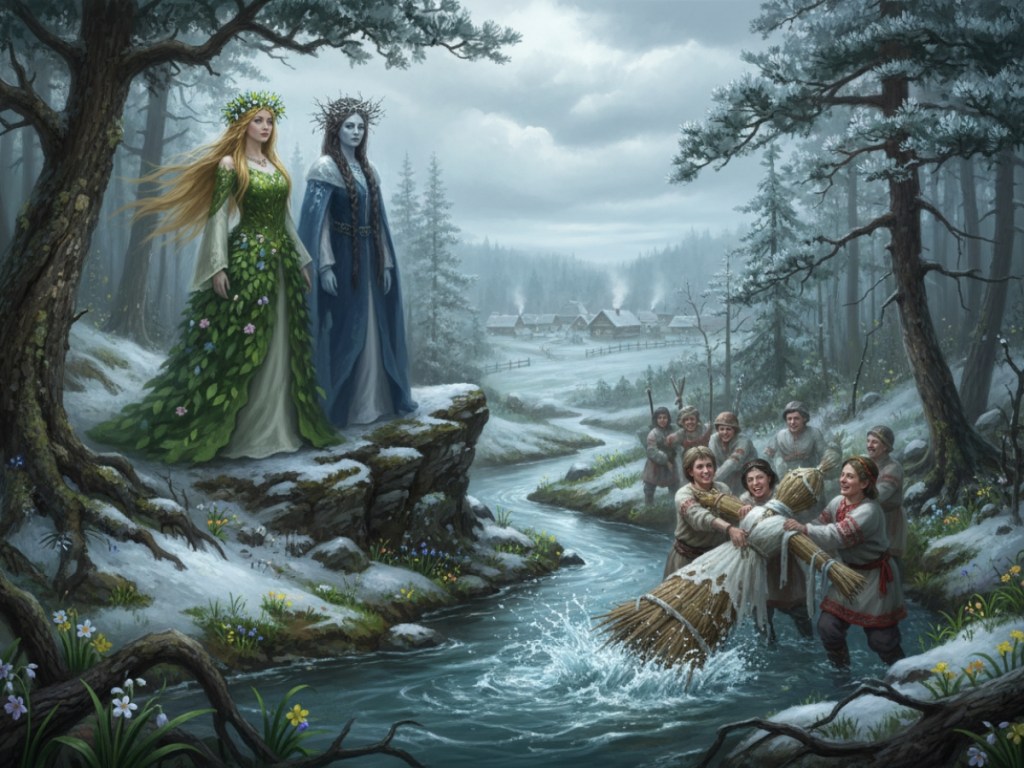
The tension that made the seasons change was a necessary constant that propelled the Slavic world forward. The dichotomy and the complex relationship between the two goddesses reinforces the idea that people imbued their deities with common human qualities, such as envy, competitiveness, and desire for power.
Vesna’s Appearance
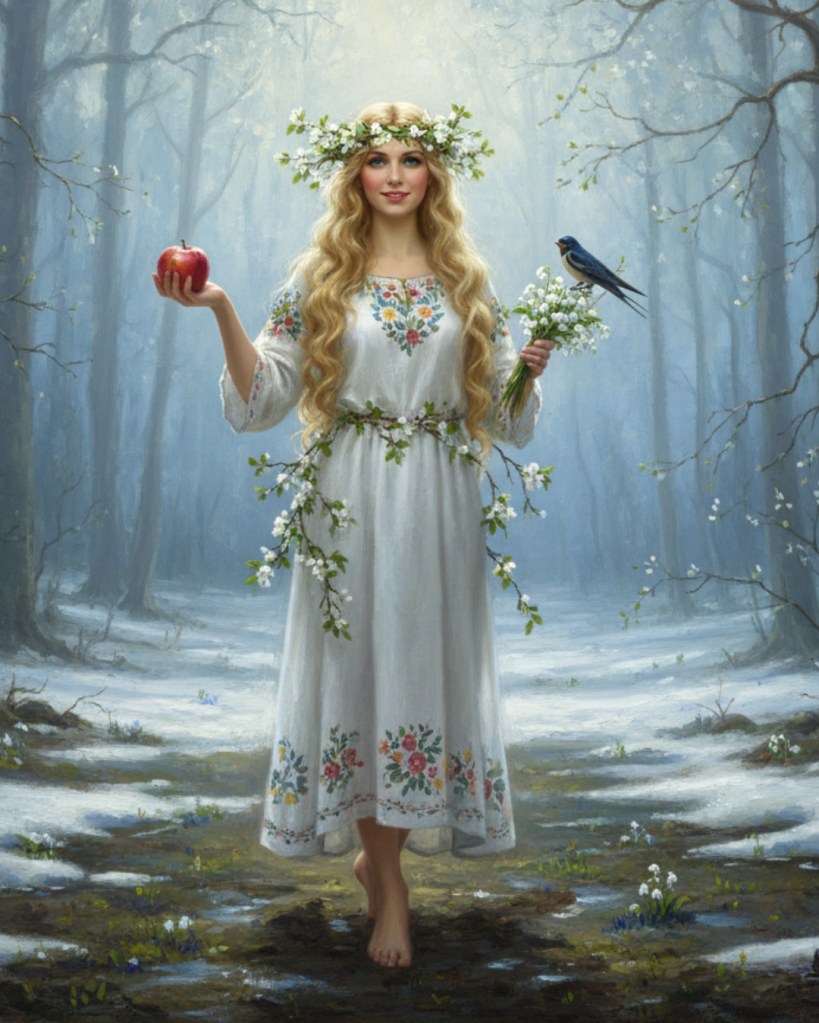
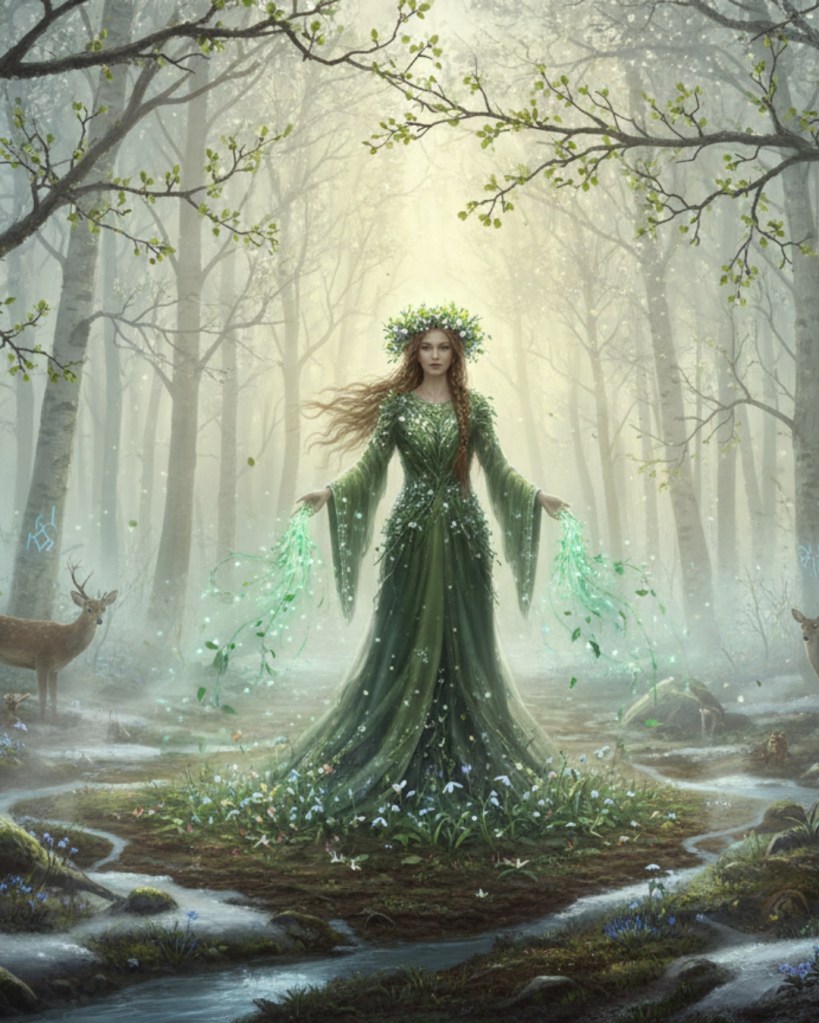
Vesna is represented as a beautiful young woman, usually wearing a white dress decorated with wreaths and flowers. There is a particularly large wreath around the lower part of her waist that symbolises fertility. Her arrival was announced by the migratory birds such as swallows, storks, and cuckoos.
She is often portrayed as a smiling, barefoot girl, with long hair and rosy cheeks. Sometimes she holds fruit in her hands, usually an apple, other times she is presented with a swallow and flowers that symbolise spring and marriage respectively.
Vesna’s strength is not dramatic. She does not command storms or freeze rivers. Her power lies in persistence.
She is the reason the frozen ground softens. The reason seeds, buried and forgotten, begin to rise. The reason light returns, day by day, almost unnoticed until it is undeniable.
She reminds us that change does not always arrive loudly.
Sometimes, it grows.
The Beloved Goddess
Slavs perceive Vesna as their ally. There are numerous prayers and rituals that were performed to summon the spring goddess and force the malicious winter out of the home. It was believed that Vesna had the power to restore health and natural balance, which would result in a harmonious and fertile life. She was especially revered amongst newlyweds. The general rebirth of nature was celebrated in a number of ways.
Children would play with the pussy willow catkins and make bellflower wreaths, eggs were painted in red symbolising the sun and the heat brought by Vesna, girls decorated with flower wreaths and leaves would sing songs to the goddess, and swallows that would start returning from their winter migrations, were sometimes equated with Vesna’s arrival on the wings of Stribog’s wind.
Even now, Vesna feels familiar.
Not as a figure we worship, but as a rhythm we recognise. The slow return of energy after a difficult period. The cautious beginning of something new. The sense that, despite everything, life continues to move forward.
We all have our winters. Periods of stillness, of waiting, of quiet endurance.
Vesna does not erase them. She follows them.
And in doing so, she offers something gentler than certainty. Not a promise that everything will be easy, but a reminder that renewal is possible.
That even after the longest season, something in us is still capable of returning to light.
Sources & References:
Milosevic, Nikola, et al. Vesna, Stari Sloveni, Staroslovenska Mitologija, Religija i Istorija, http://www.starisloveni.com/Vesna.html.
Parkes, Veronica. “A Cycle of Life and Death: Slavic Goddesses Morana and Vesna.” Ancient Origins, Ancient Origins, 10 Nov. 2016, http://www.ancient-origins.net/myths-legends/cycle-life-and-death-slavic-goddesses-morana-and-vesna-006984.
Copyright Note
All Slavic deities, spirits, and mythological creatures appearing on Myths & Stories are explained as truthfully as I found them in the sources—though remember, myths have many voices and each source may sing a slightly different tune.
The retellings, poetic twists, and original stories here are my own creations. Please don’t borrow them without asking first.
© ernawrites.com



 Myths & Stories
Leave a comment