There is something strange about creating in times like these.
The noise isn’t the kind you can turn down. It isn’t traffic or a television left on in another room. It’s the particular loudness of a media cycle that has learned to live on dread, the one that needs you frightened and refreshing the page, needs the worst interpretation of every event to be the first one you reach.
You open your phone in the morning and the world has already decided what to feel about something that happened three hours ago. There are hot takes and counter-takes and footage that may or may not be what it claims to be. There are headlines designed not to inform but to destabilise.
And underneath all of it, you can’t always tell what’s real.
The fake news conversation has grown so exhausted that we’ve stopped noticing how genuinely corrosive it is, not just politically, but psychologically. When you can’t trust what you’re reading, you start to feel unmoored from reality itself. A low-level anxiety that has no clear object. Dread that attaches to whatever you read last.
Writing is how I hold still.
Not as a solution. Not as resistance, exactly. But because the noise gets inside and the only way I know to find myself again, to locate something that feels like my own perception rather than a borrowed one, is to sit down and make something. I’ve written about writing as a mental health practice — but in times like these, it becomes something harder to categorise than that. Writing is how I step into the eye of the hurricane. Everything still raging just outside. And in the middle of it, briefly, something quiet and mine.
Living as an expat sharpens this. In Dubai, I carry the news of several places at once: the country I came from, the region I live in, the world my friends in other time zones are processing at different speeds. There is no single story to hold. Expat life strips away the comfortable buffer of familiarity, the particular blindness that a stable, rooted life can offer. You are always, on some level, aware of the distance between where you are and where things are understood differently. We go to work. We go out for dinner. We build routines. We maintain normalcy with a kind of stubbornness, because normalcy, in this context, is not denial; it is a choice. Dubai is our chosen home, and you protect what you’ve chosen. And when the noise gets loud enough to rattle even that, writing becomes less of a habit and more of a necessity. A way of knowing where I stand when the ground keeps shifting.
I am not alone in this. Artists have always done it — made things in the middle of difficulty, not after it resolved, not when conditions improved. Made things precisely because conditions didn’t improve.
Because that, I think, is what art has always been for. Not to record. Not even to protest. But to say: this is what it felt like to be alive in this moment. This is what I saw. This is what I knew to be true, even when everything around me insisted otherwise.
History, it turns out, agrees.
What History Already Knows
When the Spanish flu swept through the world between 1918 and 1920, killing somewhere between 50 and 100 million people, something happened in parallel that we don’t always talk about: an enormous flourishing of art. The 1920s didn’t appear from nowhere. They were built, in part, by people who had survived catastrophic loss and needed somewhere to put it. Fitzgerald. Woolf. The Harlem Renaissance. Jazz. All of it shaped by grief that had nowhere clean to go.
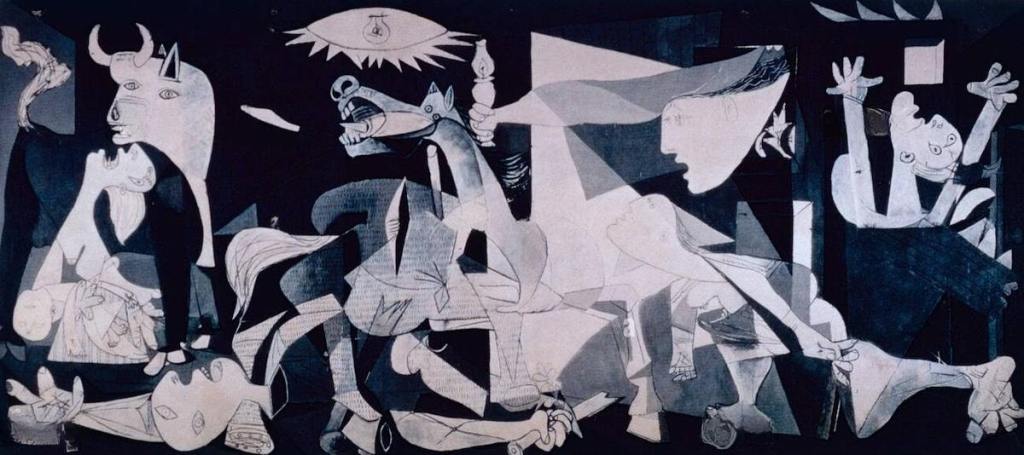
Picasso painted Guernica in 1937, in the weeks after the bombing of a Basque town during the Spanish Civil War. He had been commissioned to make something for a world exposition. He made that instead: the horse screaming, the lamp held up like a question, the bodies arranged in fragments. It wasn’t a beautiful painting. It wasn’t supposed to be. It was a document of what happens to civilians when history decides to move through them.
And yet it survived. It is still surviving.
Drawing From Exile
Marjane Satrapi was a child in Tehran when the Iranian Revolution reshaped everything around her. She drew Persepolis decades later, in Paris, from exile. The distance didn’t dilute it. If anything, the years between the living and the making gave her something she couldn’t have had in the middle of it — the ability to hold the child she was with some tenderness, to let the story breathe. She chose comics deliberately. She said it herself: the form could reach people that dense political writing couldn’t. Black and white. Simple lines. Enormous things made somehow holdable on the page.
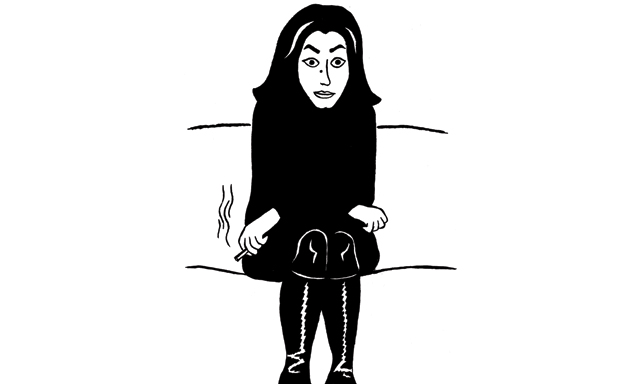
What she made was not exactly a historical document. It was closer to an act of return — going back into the chaos of a country mid-revolution, a war that killed people she loved, an exile that never fully resolved, and finding a shape for it that others could enter and understand.
What I find myself returning to, again and again, is this: the art that came out of the darkest moments wasn’t always made with the intention of mattering. It was made because the person needed to make it. The significance came later. First, there was just the act.
Writing Toward the End
There is a question I keep coming back to, which is whether creativity in a crisis is an act of resistance or an act of escape.
I’m not sure it has to be one or the other.
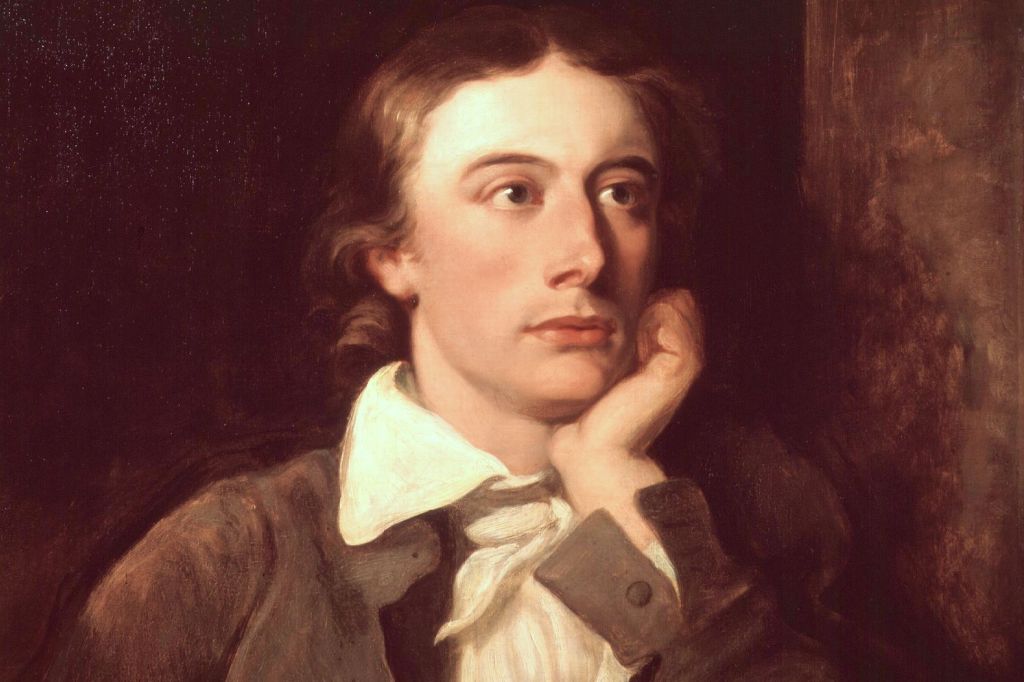
Keats wrote some of his most extraordinary odes while dying of tuberculosis. He was twenty-five. He was aware of exactly what was happening to his body. The odes are not about illness — they’re about beauty, and transience, and what it means to love a thing that doesn’t last. He wasn’t escaping. He was going deeper into the thing that frightened him, and coming back with something he could hold in his hands.
The Cellist Who Kept Playing
During the Siege of Sarajevo in the 1990s, a cellist named Vedran Smailović played Albinoni’s Adagio in the ruins of buildings that had been bombed. He played in the street. He played in dangerous places. He was not naive about the danger. He played anyway. It was not a political statement, exactly. It was something harder to categorise than that. An insistence that certain things, music, beauty, the act of listening, still belonged to the people in the city, regardless of what was being done to them.
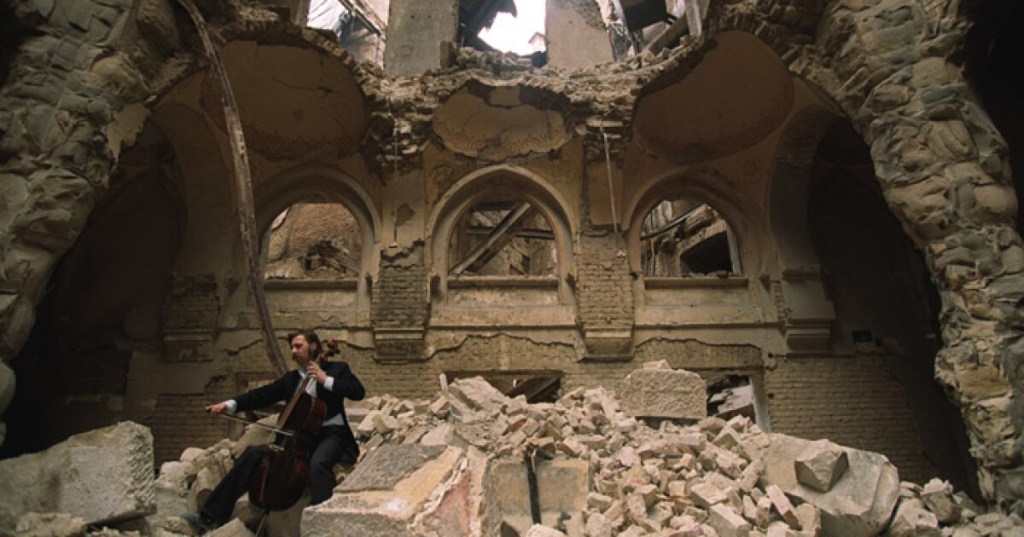
What strikes me about both of these is the specificity. Keats wasn’t writing abstractions. Smailović wasn’t playing to make a point. They were doing the thing itself, with full attention, in the middle of difficulty.
That’s the part that I think gets missed when we talk about creativity in crisis. We talk about it as if it’s primarily therapeutic, which it sometimes is, or primarily political, which it sometimes is. But mostly it’s just — the thing itself. The work, showing up, regardless of conditions.
Still Making Things
I don’t have a tidy conclusion for this.
The world is doing what the world does: it is moving in ways that feel, from our point of view, unprecedented, and which history will eventually absorb into the larger pattern of things.
And creativity, for me, has become less optional in that context, not more.
I used to think of writing as something I did when conditions were right. When I had time, and quiet, and felt settled. That version of the creative life turned out to be a fiction I was allowed to hold for a while, and then wasn’t.
What replaced it is something more practical, and also, I think, more honest. You write because you need to think. You write because otherwise the things you’re carrying just accumulate inside you and you can’t see them clearly. You write because language, when it works, does something that the news cycle cannot do: it slows things down enough that meaning becomes possible.
That feels like enough, for now.
Not because it changes anything large.
But because it keeps something small and necessary alive — the part of me that believes meaning is still worth making, even when the context for it keeps shifting.
Maybe especially then.
If any of this felt familiar, you can find me on Instagram. I share more there — small reflections on writing, creativity, and the in-between moments.
Copyright
The writing here is mine. The historical figures and events belong to history — but the way I’ve written about them, the reflections, the thread connecting them, that’s original work. Please don’t reproduce it without permission.
Sources & Further Reading
On art and the Spanish flu / the 1920s
- Laura Spinney, Pale Rider: The Spanish Flu of 1918 and How It Changed the World (PublicAffairs, 2017)
- Ann Douglas, Terrible Honesty: Mongrel Manhattan in the 1920s (Farrar, Straus and Giroux, 1995)
On Picasso and Guernica
- Gijs van Hensbergen, Guernica: The Biography of a Twentieth-Century Icon (Bloomsbury, 2004)
- Museo Reina Sofía permanent collection: museoreinasofia.es
On Marjane Satrapi and Persepolis
- Marjane Satrapi, Persepolis (Pantheon Books, 2003; originally published in French by L’Association, 2000–2003)
- Satrapi’s interviews on the making of the book, including her Paris Review conversation and various press interviews from the mid-2000s onward
On Vedran Smailović and the Siege of Sarajevo
- Stephen Galloway, The Cellist of Sarajevo (Riverhead Books, 2008) — fictionalised account based on Smailović’s actions
- Interviews with Smailović collected in various music journalism archives from the 1990s onward
On John Keats
- Andrew Motion, Keats (Farrar, Straus and Giroux, 1997)
- The Keats-Shelley House, Rome: keats-shelley-house.org


Leave a Reply