
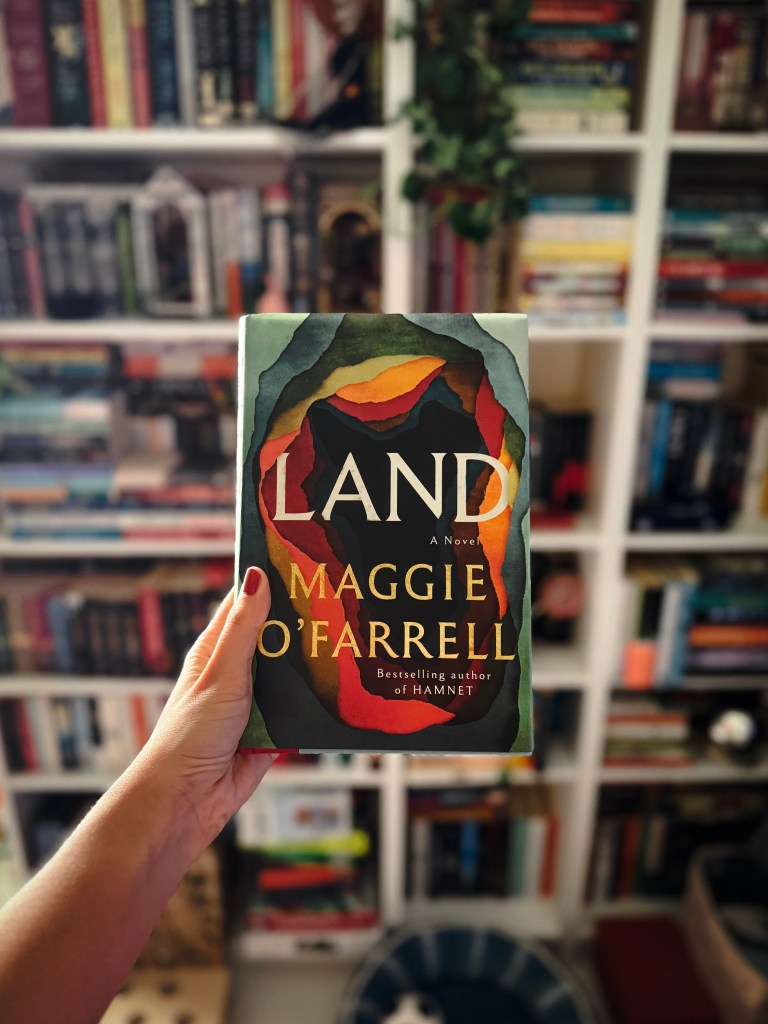
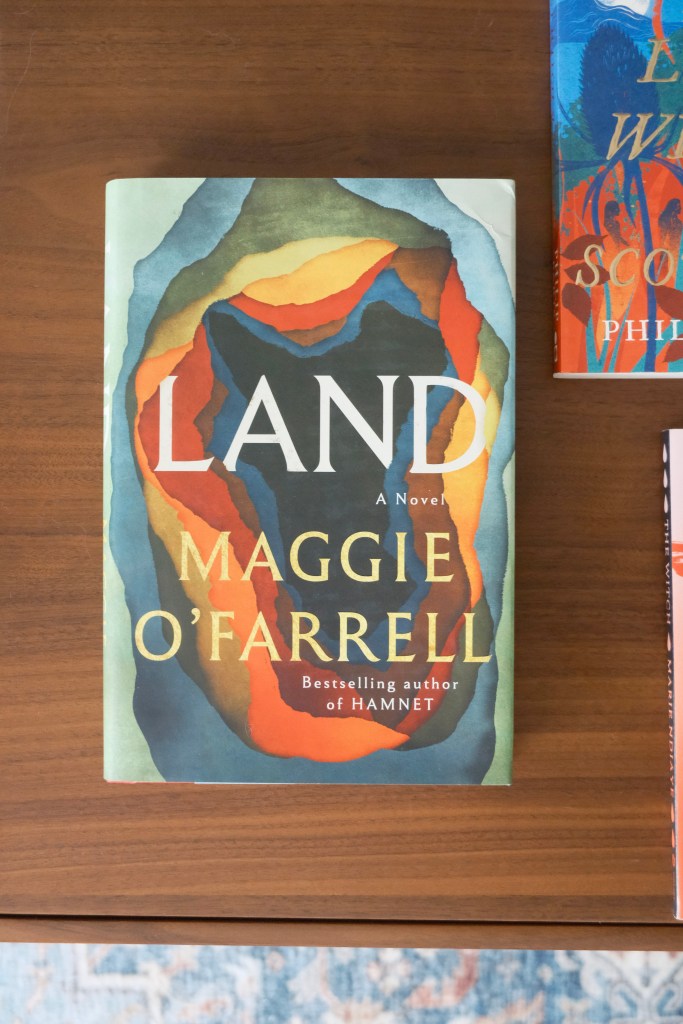
I read Land by Maggie O’Farrell a few weeks ago, and it took me time to understand how I felt about it and what I wanted to say.
O’Farrell’s book is wide open, like the land itself. She takes a place, a windswept peninsula in the west of Ireland, puts a pin in it, and follows the lives that converge there across time. It’s a story of history and power, of family, land, and emigration.
The novel opens, seemingly arbitrarily, in 1865. Ireland is still struggling to recover from the Great Hunger, which peaked between 1845 and 1849, when a million people died and a million more emigrated. With so many of its inhabitants gone, the British are keen to remap the country. This is when we meet Tomás, a brusque yet diligent and thorough mapmaker, and his ten-year-old son Liam, a shivering boy in a handed-down jacket. Both work for the Ordnance Survey, painstakingly charting a new map of Ireland.
For Tomás, mapmaking was the only way out of a downright Dickensian workhouse. But it is also an act of both colonisation and resistance, of assuming power and of rewriting history. Tomás walks into an unmapped copse and comes back transformed, ‘a wild-haired man-creature’. From then on, he wants to write the truth of his land onto paper and preserve its story. Yet mapmaking has its limits. Not everything can be written down, and a landscape this complex can’t be mapped out entirely truthfully.
When he returns home, we meet the rest of the family: his wife Phina, their two daughters, Enda and Rose, who couldn’t be more different, and, later on, Eugene, who never learns to speak. However, judging by the parts of the narrative told from his perspective, Eugene understands a great deal, and may even have something of a gift. What follows are years of deaths and betrayals, and the family inevitably scatters. What remains is the land, the Irish countryside that resists both mapping and colonisation.
O’Farrell’s form is rolling and changing, much like that countryside. The narrative isn’t linear. Plots, times, places, and perspectives intrude upon one another, and chronology loosens. The peninsula stays at the centre, seen through the lives that cross it and the centuries that pass over it. There’s Tomás’s family in the house on the clearing, and there’s Brith and her dog underground. Her imagery is so precisely woven that it feels like looking through a lens: sharp in focus, a little blurry around the edges, utterly cinematic.
I truly enjoyed it. The narrative, the imagery, and above all O’Farrell’s ability to bind the life and the land to the paper. Land is her tenth novel. Of her earlier work, it was Hamnet that drew the highest praise and was turned into a film.
Land is a novel that leaves you thinking. Like Tomás, I wanted to get it down truthfully, and I’m not sure all of it fits on the page.
If you want more bookish content, reviews, and the occasional poem, you can find me on Instagram. I’m there more than I probably should be.
PS. All photos in this post are mine. I’d be grateful if you didn’t use them without permission.


Leave a Reply