
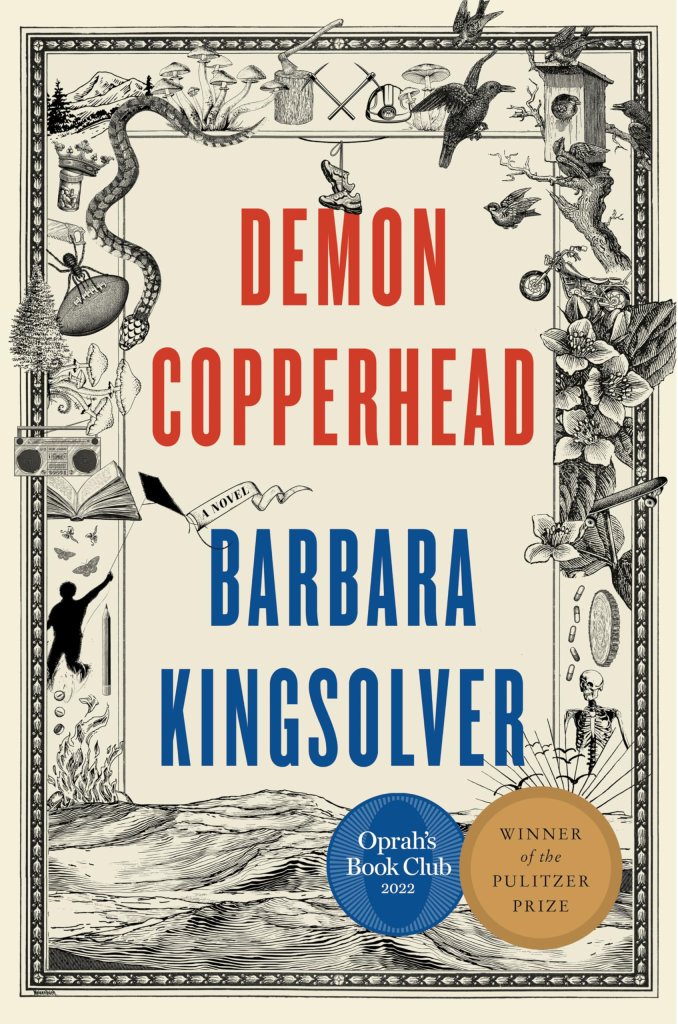
I approached Barbara Kingsolver’s Demon Copperhead with the particular wariness reserved for books that arrive already garlanded with praise. The Pulitzer. Oprah’s Book Club. Raving reviews online. The kind of unanimous applause that makes a reader suspicious before they’ve even cracked the spine.
I was wrong to hesitate.
The Boy Behind the Name
His real name is Damon Fields. Born in a trailer in Lee County, Virginia, to a teenage mother who can barely take care of herself, with no one particularly waiting for him. He will be failed by almost every institution that was designed, in theory, to help him. Foster care. Schools. The healthcare system. In a state so gutted by economic abandonment that there is almost nothing left to catch the people who fall.
He narrates his own story, and Kingsolver gives him a voice so alive, so specific, so full of clarity about exactly what’s being done to him and by whom, that you can’t look away. Demon is funny. He’s furious. He sees things with a precision that children in his position are not supposed to have. He draws comics. He observes the adult world around him with the focused attention of someone who learned early that information is the only currency he has.
I kept thinking of Holden Caulfield, of that same magnetic, first-person pull. But where Holden is a boy of privilege circling an existential crisis of his own making, Demon is a boy from Appalachian America being processed by systems that see him as a problem to be managed. The magnetism is similar, but everything else is different.
“Live long enough, and all the things you ever loved can turn around to scorch you blind. The wonder is that you could start life with nothing, end with nothing, and lose so much in between.”
He doesn’t say this with self-pity. That’s the thing about Demon. He’s not performing suffering for you. He’s just telling you what happened.
The Place
Lee County doesn’t show up much in the kind of fiction that gets reviewed in the literary press. When Appalachian America does appear in the wider culture, it tends to arrive in the form of stereotype: the hicks, the rednecks, the punchline in someone else’s story about what the mainstream America thinks. Kingsolver doesn’t do that. She writes the place from the inside: the hollers, the fog, the particular texture of a community that had already been hollowed out by the time anyone noticed, if they noticed at all.
This is a region that was poor before the opioid crisis and even poorer after. A place where the economy left and the pharmaceutical companies arrived, and the two things are not unrelated.
Ragged Kids in an Indifferent System
Demon and his best friend Maggot are the kind of children who didn’t have a great start in life. They’re hungry. They’re wearing clothes that don’t fit. They’re doing what children do, which is making a world out of whatever scraps are available, but the scraps are thin and the adults around them are, for the most part, too broken to be of much use.
The foster care system is not a villain in this novel so much as it is a machine that chews through children. No single person is the problem. The problem is the whole architecture: underfunded, overwhelmed, and designed in a way that allows harm to happen at a very low volume, repeatedly, over years, without anyone being technically at fault. Kingsolver is too honest a writer to make this simple. The people who fail Demon are often people who were failed first. That doesn’t make it better. It just makes it true.
From Star Player to Pain Pills
There’s a section of the book that I keep thinking about, which I won’t detail too much here in an attempt not to spoil the read entirely, where Demon finds something he’s genuinely good at, something that earns him recognition, a sense of belonging, a future that looks like it might actually work for him. And then an injury. Followed by a prescription.

This is how it happened, Kingsolver is telling us. Not through weakness or bad character or the absence of moral fibre. But through a system that handed pills to athletes with injuries, watched them get hooked, and then, when the prescriptions dried up, left them with a need and no way to meet it except the cheaper option. Big pharma created the supply. The communities bought it because they were in pain. The doctors prescribed it because they were told it was safe and they earned a commission from the prescription. Kingsolver doesn’t flatten any of this into a single accusable party. She just shows you what happens when every link in the chain fails at once.
“Everybody warns about bad influences, but it’s these things already inside you that are going to take you down. The restlessness in your gut, like tomcats gone stupid with their blood feuds, prowling around in the moon-dead dark.”
The ‘wanting disease,’ Demon calls it. Not an excuse or an explanation. A disease, and the difference matters.
Dickens, and What Kingsolver Does With Him
The Dickens parallel (this is a retelling of David Copperfield) is more interesting than it sounds. What Kingsolver is pointing at is not literary decoration. The argument is embedded in the structure: the themes of David Copperfield, the abandoned child, the corrupt institutions, the exploitation of the poor, the way Victorian England produced suffering at industrial scale, are relocated to southwest Virginia in the early 2000s. And Demon’s conclusion that ‘a kid is a terrible thing to be, in charge of nothing’ would resonate extremely well with Dickens. The characters of Dicken’s David and Kingsolver’s Demon follow a similar arc:
David is sent off to the gloomy Salem House, run by Mr Creakle, and Demon gets farmed out to a tobacco farmer’s grey, joyless house, finds his Steerforth in a charismatic quarterback who runs pharm parties and calls himself Fast Forward. But you don’t need to know any of that. The characters work on their own terms, without the literary scaffolding.
He lands, eventually, with a football coach and his daughter Angus, one of the better things that happens to him, which is a low bar but a real one. He’s good at the game. For a while it looks like something might hold. Then an injury, a prescription, and the familiar slide.
The political intent is there throughout the book, but Kingsolver does not make it too obvious. It moves beneath the surface of the story, present in what she chooses to show and how she chooses to frame it. You feel it more than you hear it.

Telling the Story as the Means of Survival
One of the novel’s quiet achievements, and one I found unexpectedly moving, is how it makes Demon’s narration part of the story itself. He’s telling this tale after the fact. He’s putting it in order. Early on, he says the telling is meant to make things clear: that he came late to understanding the problem of himself, and might still not have, if not for this.
He is a product of failed systems: foster care, schools, healthcare, an entire regional economy that collapsed. But he owns his story. Naming it, narrating it, giving it shape – this is how he accounts for what happened, and how he makes it mean something beyond mere survival. That Kingsolver can hold this alongside everything else the book is doing, such as the social critique, the historical parallel, the specific grief of addiction, without it all collapsing into one another and making the reader feel overwhelmed by references, is the real achievement.
Why Demon Copperhead Deserved the Hype
I was wrong to be suspicious. Demon Copperhead does what the novel was built to do: it pulls you inside a life you might otherwise never enter and makes you feel its full weight. Demon isn’t a metaphor, a symbol, or a vessel for the author’s argument. He’s a person, specific, imperfect, occasionally infuriating, and utterly unforgettable.
Read it. Enjoy it.
If you want to talk books, you can find me on Instagram. I’m there more than I probably should be.


Leave a Reply